It has been so long since I've been able to write here. I had very nearly forgotten that I had a blog at all. I think the last post I made was almost two years ago. So much has happened, so much has changed. There are even some things that have stayed the same. I doubt anyone has stopped by here for quite some time, and probably won't for some time to come...
Ah, the reason for my departure.
John Lennon once said that life is what happens while you're making other plans, so I suppose life itself has kept me from writing. I am in the junior year of my college experience - plenty of good stories, but all in good time - and I only have one more year before I am officially a college graduate. I have been so busy with my studies, but I am learning so much. I feel as if I have grown tremendously, and some memories from the past that were once so clear have faded into obscurity. There are some things I think I will always remember, and some things, when I detect the shadow of their absence, I wish I had not forgotten. So many experiences in the last two years have lead me to question my self in ways I had hitherto never believed possible, and yet I know I have only scratched the surface.
My identity, who I thought I was, seems to be chipping away. During the busy day, when appointments dominate my mind and the whole of my mental energy is directed toward pushing myself further, harder, I almost become lost. But at night, in the stillness at the dark edge of sleep, I feel closer to my true self than ever before. I feel as though I am groping in the dark, so close to what I am searching for but helpless to find it. It is there, beyond the scope of my perception. A barely audible whisper amidst my churning, howling mind. The Vedas say that the True Self is present in deep, dreamless sleep, and that the waking world is an illusion.
When I wake up it is back to the world of appointments, juggling obligations and various relationships. But always in the back of my mind is that whisper.
----
I would like to post some of my papers from school up here. There are a few I am particularly proud of, and maybe posting them will help me get back into the habit of updating on here. But again, the hindrance is a lack of time versus material. There may be some formatting issues but I will burn that bridge when I come to it.
Friday, March 5, 2010


Friday, March 28, 2008
Where Do We Go From Here?
It would seem to be an oft-overlooked assumption, the sensation of freedom...freedom in the sense that I choose how I act and what I do. But how can this be? I do not choose to exist; this, whether a glorious gift or unbearable burden, seems absolute. I do not choose the time or circumstance of my birth, nor do I choose how I am to be raised or who is to raise me. I do not choose the nature of the universe or the extent of its natural laws. I do not choose the desires of my fragile body, or the thoughts of my elusive mind. I do not choose my personality, or the temperaments and dispositions embedded within my DNA. Furthermore, when pressed it would seem that any idea of a self, a continuous and unchanging ego or soul, is an illusion created for convenience but bought into out of craving. I do not choose to be a link in the chain of cause and effect, yet every action I take is tethered inevitably to some effect outside of my control. Is freedom to be defined as the ability to react to one's circumstance? But this answer is lacking; how can any action or being be free when it MUST act and, by virtue of its circumstance, act in a certain way?
I see this chain of cause and effect, so fittingly named since it binds us, as the karma that Siddhartha Gotama spoke about. It is not a mystical cycle or magical retribution, it is simple cause and effect, at times shrouded from our understanding due to the complicated nature of the universe. But Gotama also spoke about freedom. He spoke about liberation, and freeing ourselves from delusion and suffering. Is the delusion our illusion of free will? Of personhood? Our suffering is self-created, so why not our freedom as well? Perhaps the release that he spoke about is merely an understanding of our cosmic circumstance. Perhaps we are like leaves on a river, seemingly free but ultimately powerless to change our path. The difference between us and the leaves is that we have the uncanny ability to percieve our circumstance.
The answer might lie in the question. When I ask, "Do I have free will?" I may be begging the question. I assume there is an "I" to possess free will. Is this the resolution? Is the question of free will an absurd one, since it relies on assumption? Perhaps, but it gives rise to another question: what is it that I percieve to be myself? Gotama called the self nothing more than an illusion based on the five skandas, but does this explain my consciousness? Does this answer WHY I am aware of my lack of free will?
It does not.
**NOTE: This is an edited version of something I wrote in a more formal setting, so it definitely breaks rank with my normal posts. I thought I would throw it on here since I've been thinking a lot about free will recently.
I see this chain of cause and effect, so fittingly named since it binds us, as the karma that Siddhartha Gotama spoke about. It is not a mystical cycle or magical retribution, it is simple cause and effect, at times shrouded from our understanding due to the complicated nature of the universe. But Gotama also spoke about freedom. He spoke about liberation, and freeing ourselves from delusion and suffering. Is the delusion our illusion of free will? Of personhood? Our suffering is self-created, so why not our freedom as well? Perhaps the release that he spoke about is merely an understanding of our cosmic circumstance. Perhaps we are like leaves on a river, seemingly free but ultimately powerless to change our path. The difference between us and the leaves is that we have the uncanny ability to percieve our circumstance.
The answer might lie in the question. When I ask, "Do I have free will?" I may be begging the question. I assume there is an "I" to possess free will. Is this the resolution? Is the question of free will an absurd one, since it relies on assumption? Perhaps, but it gives rise to another question: what is it that I percieve to be myself? Gotama called the self nothing more than an illusion based on the five skandas, but does this explain my consciousness? Does this answer WHY I am aware of my lack of free will?
It does not.
**NOTE: This is an edited version of something I wrote in a more formal setting, so it definitely breaks rank with my normal posts. I thought I would throw it on here since I've been thinking a lot about free will recently.
Monday, June 25, 2007
Secrets, secrets are no fun...
...unless they're shared with everyone! Which is, apparently, just what is happening. "The Secret" is on all sorts of Best Seller lists and is marketed as both a self-help and spiritual book. But it has come under fire from psychologists and others because the slightly kooky and well-meaning message could have severely damaging effects, which I may or may not talk about in a later post.
First, let's talk about the glaringly obvious point illustrated by the hyperlinked CNN article above, which has L. Ron Hubbard-esque qualities surrounding it. Hubbard was the founder of the Church of Scientology and the original author of Dianetics, the first framework of said Church. But Hubbard was quoted on numerous occasions as saying, "If a man really wanted to make a million dollars, the best way to do it would be start his own religion. " or some variant*. Does it seem odd that he is quoted saying these things c. 1948 or 1949, and then coincidentally starts up Scientology in 1953? When one of the main practices in the CoS is to charge ridiculous amounts of money for classes teaching secrets of the religion, or the ultimate truth? Hmm...
Now, as I was saying, "The Secret" smells of the same chicanery. Actually, it stinks of it. The CNN article above talks about the creator of "The Secret", Rhonda Byrne , "She said she was struggling personally and professionally several years ago when she was given a nearly 100-year-old book called "The Science of Getting Rich," by Wallace D. Wattles. In it, readers are guaranteed to become wealthy if they learn and follow "certain laws which govern the process of acquiring riches." The emphasis was added by me to stress what comes in the next paragraph:
"Inspired to do further research, Byrne said, she resolved to create a film to spread the word about what she felt she had learned about the "law of attraction." "
A film which she just so happens to be marketing as a revolutionary wealth-generating system and, apparently, becoming insanely rich off of. It is a wonder that the ancient book she read wasn't titled, "How to Scam a Nation Into Making You Rich", as that seems to be what she learned. Hell, maybe her "secret" of positive reinforcement and visualization actually does work. After all, the ancient text was about how to get rich, and she obviously did. There is a very logical way to prove that Byrne's act of creating The Secret is neither rational nor moral, if it indeed functions as she proposes.
German philosopher Immanuel Kant coined the term "Categorical Imperative". In his words, "Act only according to that maxim whereby you can at the same time will that it should become a universal law."** In my words, "An act is immoral if you wouldn't want everyone and his cousin to do the exact same thing." Categorical Imperatives are true no matter the situation or the particular details surrounding it. So...why does it matter? Kant created the Categorical Imperative to show a universal set of ethics. You see, Kant believed that we are morally obligated to only make decisions that are acceptable for everyone else to make. This approach has two prongs: one is that it means we are all equal in that no one person has moral rights that another does not, and the second is that we are forced to admit that in certain circumstances, the universality of an action would create a contradiction, thus proving that it is morally wrong and should not be done. It would seem Kant believed that immoral actions weren't a sin, just irrational.
Example, anyone? Let's use The Secret. Byrne claims that her motivation behind publishing The Secret is to help everyone get rich. Being rich means having great wealth, and as we all know via inflation and economics, wealth is relative. As such, using the Categorical Imperative, if everyone were rich, no one would be rich, and thus the entire argument collapses upon itself in a contradiction of conceivability. It stands to reason through this simple excercise in logic that not only is it impossible for everyone to be rich like Byrne claims, Byrne must also be deceiving us as to the effectiveness of The Secret, since she cannot honestly will everyone in the world to be rich, lest no one be rich, thereby voiding her actions. It don't work the way she say it do.
Byrne is conscious of this, or could be made conscious of it very easily through the above excercise. In saying that The Secret works for everyone she is lying.The Secret does work. But only for her. The basis of HER path to wealth is through scamming people. And, once again, if EVERYONE scammed people, no one would trust anyone else and thus no one could be scammed, resulting in another contradiction and another immoral action.
I don't really blame people like Byrne, or Hubbard. True, they should absolutely positively be held responsible for the things that they do, and purposefully ripping off hundreds of thousands of people is a serious deal. But COME ON! A book claims that you can acquire wealth and anything else you want just by thinking about how much you want it? Use that brain a little bit before you whip out the charge card! You're responsible for your own shit, and you always will be. Just because slick salesmen or flashy products exist doesn't mean you aren't responsible for the things you do. There's no such thing as a free lunch. Or a free diamond necklace, or hunky lifeguard, or...
People are fooled because they want to be. Everyone who buys into Scientology, The Secret, and similar snake oils knows in their heart of hearts that what is promised can't possibly be true. And yet people line up by the buttload to shovel out their hard-earned cash to buy this crap. Tell you what: instead of spending your money on the next tier of Scientology classes or the latest Secret DVD, why not, oh I dunno...put it in the bank? Sock drawer? Work towards acquiring what you want instead of sitting around thinking about how much you want it.
*-- Bare Faced Messiah p.148. Reference given to LA Times, 27 Aug 78. Supposed to have happened in spring 1949.
**Kant, Immanuel; translated by James W. Ellington [1785] (1993). Grounding for the Metaphysics of Morals 3rd ed.. Hackett, p30. ISBN 0-87220-166-x.
First, let's talk about the glaringly obvious point illustrated by the hyperlinked CNN article above, which has L. Ron Hubbard-esque qualities surrounding it. Hubbard was the founder of the Church of Scientology and the original author of Dianetics, the first framework of said Church. But Hubbard was quoted on numerous occasions as saying, "If a man really wanted to make a million dollars, the best way to do it would be start his own religion. " or some variant*. Does it seem odd that he is quoted saying these things c. 1948 or 1949, and then coincidentally starts up Scientology in 1953? When one of the main practices in the CoS is to charge ridiculous amounts of money for classes teaching secrets of the religion, or the ultimate truth? Hmm...
Now, as I was saying, "The Secret" smells of the same chicanery. Actually, it stinks of it. The CNN article above talks about the creator of "The Secret", Rhonda Byrne , "She said she was struggling personally and professionally several years ago when she was given a nearly 100-year-old book called "The Science of Getting Rich," by Wallace D. Wattles. In it, readers are guaranteed to become wealthy if they learn and follow "certain laws which govern the process of acquiring riches." The emphasis was added by me to stress what comes in the next paragraph:
"Inspired to do further research, Byrne said, she resolved to create a film to spread the word about what she felt she had learned about the "law of attraction." "
A film which she just so happens to be marketing as a revolutionary wealth-generating system and, apparently, becoming insanely rich off of. It is a wonder that the ancient book she read wasn't titled, "How to Scam a Nation Into Making You Rich", as that seems to be what she learned. Hell, maybe her "secret" of positive reinforcement and visualization actually does work. After all, the ancient text was about how to get rich, and she obviously did. There is a very logical way to prove that Byrne's act of creating The Secret is neither rational nor moral, if it indeed functions as she proposes.
German philosopher Immanuel Kant coined the term "Categorical Imperative". In his words, "Act only according to that maxim whereby you can at the same time will that it should become a universal law."** In my words, "An act is immoral if you wouldn't want everyone and his cousin to do the exact same thing." Categorical Imperatives are true no matter the situation or the particular details surrounding it. So...why does it matter? Kant created the Categorical Imperative to show a universal set of ethics. You see, Kant believed that we are morally obligated to only make decisions that are acceptable for everyone else to make. This approach has two prongs: one is that it means we are all equal in that no one person has moral rights that another does not, and the second is that we are forced to admit that in certain circumstances, the universality of an action would create a contradiction, thus proving that it is morally wrong and should not be done. It would seem Kant believed that immoral actions weren't a sin, just irrational.
Example, anyone? Let's use The Secret. Byrne claims that her motivation behind publishing The Secret is to help everyone get rich. Being rich means having great wealth, and as we all know via inflation and economics, wealth is relative. As such, using the Categorical Imperative, if everyone were rich, no one would be rich, and thus the entire argument collapses upon itself in a contradiction of conceivability. It stands to reason through this simple excercise in logic that not only is it impossible for everyone to be rich like Byrne claims, Byrne must also be deceiving us as to the effectiveness of The Secret, since she cannot honestly will everyone in the world to be rich, lest no one be rich, thereby voiding her actions. It don't work the way she say it do.
Byrne is conscious of this, or could be made conscious of it very easily through the above excercise. In saying that The Secret works for everyone she is lying.The Secret does work. But only for her. The basis of HER path to wealth is through scamming people. And, once again, if EVERYONE scammed people, no one would trust anyone else and thus no one could be scammed, resulting in another contradiction and another immoral action.
I don't really blame people like Byrne, or Hubbard. True, they should absolutely positively be held responsible for the things that they do, and purposefully ripping off hundreds of thousands of people is a serious deal. But COME ON! A book claims that you can acquire wealth and anything else you want just by thinking about how much you want it? Use that brain a little bit before you whip out the charge card! You're responsible for your own shit, and you always will be. Just because slick salesmen or flashy products exist doesn't mean you aren't responsible for the things you do. There's no such thing as a free lunch. Or a free diamond necklace, or hunky lifeguard, or...
People are fooled because they want to be. Everyone who buys into Scientology, The Secret, and similar snake oils knows in their heart of hearts that what is promised can't possibly be true. And yet people line up by the buttload to shovel out their hard-earned cash to buy this crap. Tell you what: instead of spending your money on the next tier of Scientology classes or the latest Secret DVD, why not, oh I dunno...put it in the bank? Sock drawer? Work towards acquiring what you want instead of sitting around thinking about how much you want it.
*-- Bare Faced Messiah p.148. Reference given to LA Times, 27 Aug 78. Supposed to have happened in spring 1949.
**Kant, Immanuel; translated by James W. Ellington [1785] (1993). Grounding for the Metaphysics of Morals 3rd ed.. Hackett, p30. ISBN 0-87220-166-x.
Friday, June 22, 2007
Saturday, May 5, 2007
Hungry Hungry Buddha

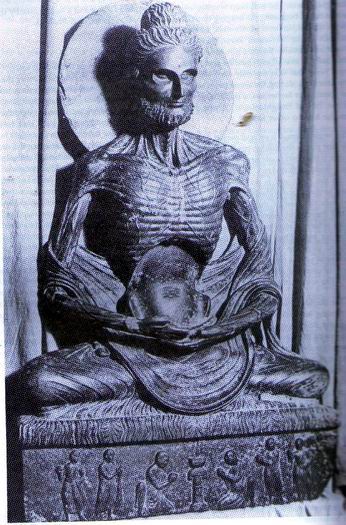
May 2nd was Vesak, the "official" Buddha Day or whatever you'd like to call it. It was established by the World Fellowship of Buddhists in 1950 as Guatama's holiday, celebrating his birth, enlightenment, and death. It follows the astrological calander and supposedly corresponds to those three events in some way, but that, like everything else, is up for debate. Either way, I decided to celebrate it by fasting this week. To clarify, I haven't fasted much and in retrospect this was more serious than I anticipated (though nothing compared to gross Buddha fasting ). I decided that I wouldn't eat anything all week, but that I would drink normally as long as it wasn't a protein shake or smoothie or something. I really wanted to do this because I think it's easy for Buddhists (or anyone) to say that they're practicing the middle way without having experienced the extremes of what they're doing. That is to say, you don't have to get strung out on blow then go coldturkey to decide that maybe you should only have a beer or two every weekend. I just mean that it's very easy for us to say we will eat moderately when most of us only have experience with OVEReating instead of UNDEReating. Buddha, as the above hyperlinked image shows, was supposedly an ascetic for a period of several years and became positively skeletal before deciding that this probably wasn't conducive to, oh I dunno...living? So I just thought it would be an important experience for me to actually feel HUNGRY for once. Herman Hesse's Siddhartha is also one of my favorite books, and he talks a bit about fasting. So I gave it a shot!
I hadn't been that hungry over the weekend so I didn't end up eating a big meal Sunday night to tide me over for the first day. I got hungry and I found it tempting to want to snack a little. I drank plenty of water and, all in all, it wasn't that different from a normal day. I started drinking a Vitamin Water each morning and really, things didn't go that badly. I found that if I kneeled down and stood up I had pretty bad headrushes, almost to the point of not being able to see for a few seconds, and I was fatigued by the third day. I also discovered that I eat, atleast sometimes, out of boredom. I'm in pretty good shape, and at 5'6" and 120 lbs it's not like I have a lot of body fat to subsist off of, or that I'm a lazy bum . I would think, "I wanna eat some pizza and play video games" when pizza really didn't have anything to do with playing video games. I wanted to go some place to eat and hang out with friends or go on a date to lunch even though I wasn't that hungry. I wanted to eat out of habit, not necessity.
I think, especially nowadays, we tend to say/believe that we are hungrier than we actually are. It's three hours after breakfast and suddenly we're "starving". A friend of mine once said this while taking a group of Ethopians on Foreign Exchange for a tour around Burlington and they were really offended. Food is fuel, not necessarily an indulgence. While I enjoy the way a lot of foods taste, all too often we fall prey to the avarice of wanting that taste so much that we overeat, or eat when we don't need it. From now on I'm really going to try eating only as much as I need to stay comfortable and healthy. I don't mean I'm only going to eat Blandbrand Nutra Wheat Health Cereal and Powerbars, or tasteless gruel. I'm just going to stop reaching for food every time I can't think of something better to do.
**As a side note, after having a bagel and cream cheese to break the fast I ended up getting REALLY sick and booting. I'd advise anyone thinking of doing something similar to eat a little something each night, like maybe a small bowl of oatmeal or something. Otherwise you might get really sick like I did. Oh, and thanks to http://www.bustedtees.com/ for the above image. It's from one of their many hilarious t-shirts.**
Subscribe to:
Posts (Atom)